


What is a waveguide?
Waveguides are used in a wide array of applications to guide electromagnetic waves (radio waves, microwaves, or light waves) along a specific path with minimal energy loss. Without the physical constraint of a waveguide, waves would expand into three-dimensional space and their intensities would decrease according to the inverse square law. Waveguides enable the precise control, guiding, and transmission of waves. Natural occurring phenomena such as reflection, refraction, diffraction, and interference are used to control the path and characteristics of waves. They are essential components in radar systems, microwave communication, and optical fiber networks. They also find use in microwave ovens, various high-frequency electronic devices, and satellite communication.

Copper waveguides can enhance communication between satellites. Photo: Unsplash – Kevin Stadnyk.
3D printed Waveguide of copper for use in space
Metallic waveguides are crucial for communication in space, enabling the transmission of signals over long distances (thousands of kilometers). Pure copper waveguides are specially designed to guide electromagnetic waves at microwave and millimeter-wave frequencies. Copper is a favored material due to its great thermal conductivity (k-value = 401 W/(m • K) at 20 °C), and excellent electrical conductivity (σ = 59.6 x 10⁶ S/m at 20°C). This is essential for reducing signal degradation and preserving the quality of electromagnetic waves as they travel through the waveguide, a characteristic indispensable for applications demanding high frequencies and large bandwidths. Ensuring signal integrity is particularly vital in situations like satellite communications and extensive terrestrial networks.
These characteristics, as well as its resistance to radiation and corrosion, make pure copper well-suited for use in the harsh conditions of space. Use of pure copper reduces the attenuation of the transmitted radio waves. For example, copper waveguides’ attenuation could be about 0.1 dBs per meter with the frequency of 10 GHz. In comparison, the attenuation rate for aluminum waveguides could be about 0.15 dBs per meter.
In space applications, like inter-satellite links, satellite radio navigation, and point-to-point radio links, copper waveguides are typically used for frequencies in the GHz range, specifically above 1 GHz, and extending up to several hundred GHz. These applications leverage the ability of high frequency (HF) waves to transmit data over long distances and penetrate Earth’s atmosphere. They are commonly employed for transmitting high-power microwave signals in satellite communication systems for both uplink and downlink paths between Earth and satellites, for example between ground stations and geostationary satellites.
Start your 3D printing of waveguides
Benefits of waveguide 3D-printing
3D-printing waveguides offers several advantages over traditional manufacturing methods, including faster prototyping, design flexibility, and the potential for cost reduction and lightweight designs. It enables the creation of complex geometries and customized structures that might be difficult or impossible to manufacture using traditional methods.
Additive manufacturing can also simplify complex radio frequency (RF) hardware by reducing the number of parts, as direct metal printing (DMP) enables manufacturing monolithic structures, eliminating assembly, test, and integration steps.
In multi-beam satellite antennas, waveguides play a crucial role in forming and directing individual beams to create the desired coverage area on Earth. They guide and manipulate radiofrequency signals, enabling the efficient generation and transmission of multiple, focused beams simultaneously. 3D printing unlocks the full potential of multi-beam satellite antennas by increasing the capacity for multiple beams, while reducing weight and volume. Better packaging efficiencies allow more channels for more services within the limited satellite design volume.
Waveguide 3d-printing difficulties overcome
As stated in another Beamler article, the characteristics of copper made it impossible to be 3D printed until 2018. But for using copper in waveguides other difficulties had to be overcome, including achieving the required dimensional accuracy and surface finish, particularly for high-frequency applications.
Surface roughness in waveguides, caused by imperfections in their fabrication process, significantly impacts their performance, particularly at higher frequencies. This roughness leads to increased signal attenuation and scattering losses, affecting the waveguide’s efficiency. Minimizing surface roughness is crucial for achieving desired performance characteristics in waveguide-based devices.
Abrasive flow machining (AFM), post processing technology, offers a solution as a finishing process that can be effectively used to improve the surface finish of copper parts, particularly those produced by additive manufacturing or those with complex geometries. AFM utilizes a viscous abrasive medium to remove material and reduce surface roughness, making it suitable for enhancing the surface integrity of copper components. The process involves forcing the abrasive media through the workpiece under pressure, causing the abrasive particles to erode and polish the surface, as showed in the figure below.
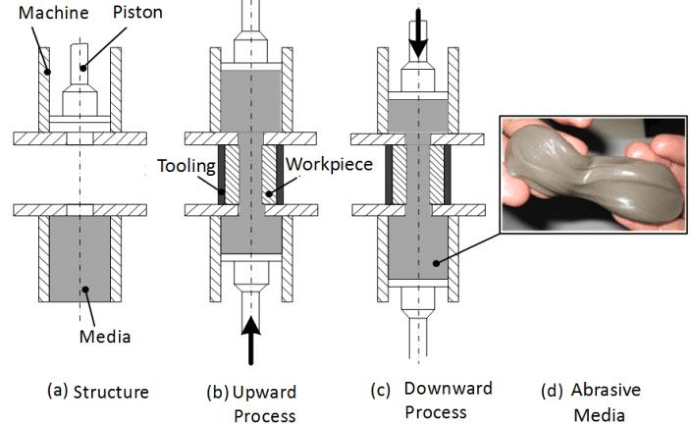
Principle of abrasive flow machining. Source: Study on Improvement of Surface Roughness and Induced Residual Stress for Additively Manufactured Metal Parts by Abrasive Flow Machining – Scientific Figure on ResearchGate. Available from: https://www.researchgate.net/figure/Principle-of-abrasive-flow-machining_fig2_325607382 (CC BY-NC-ND 4.0).
Conclusion
3D printing waveguide in copper offer lightweight, and cost-effective solutions for satellite communication, with great electrical and thermal conductivity ensuring low signal losses. 3D printing enables complex, monolithic designs ideal for space applications like inter-satellite links and multi-beam antennas. Recent advancements, such as abrasive flow machining, have overcome key challenges in copper 3D printing, improving surface finish and high-frequency performance.





3D printing is increasingly used to manufacture waveguides for satellite communication, offering advantages in terms of lightweight and cost-effective designs, and complex geometries. Specifically, 3D-printed waveguides can be used on satellites, enabling more compact and efficient communication systems. Pure copper waveguides has excellent thermal and electric conductivity ensuring low signal losses.